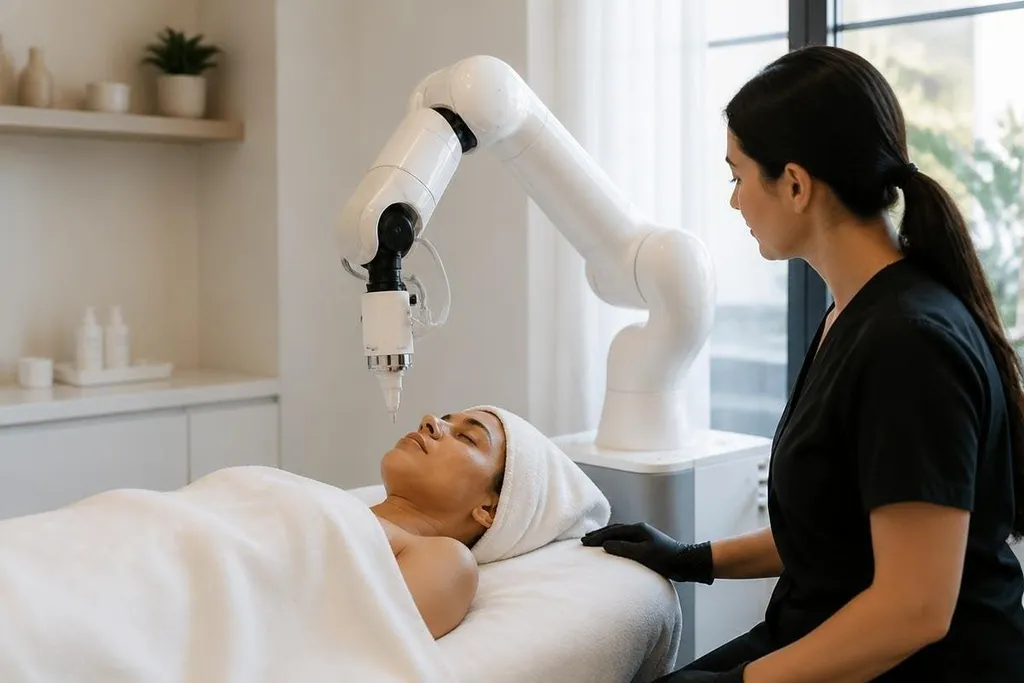
Beauty robots sit where personal care meets automation. Their appeal comes from a narrow promise: repeat a small task with steady motion, while a person controls the parts that need judgment.
Quick read
- Beauty robots are most useful for repeatable steps such as dispensing, scanning, or guided movement.
- Cameras, force sensors, and software decide how much control a person keeps.
- Price, hygiene, safety, and proof matter more than a polished demonstration.
The tasks fit automation
Many beauty services contain repeatable actions. A robot can move a nozzle along a set path, dispense a measured amount of product, or hold a tool at a fixed angle. Those jobs suit software because the task can be split into clear steps.
That does not mean a robot can replace a trained stylist or technician. Skin, hair, nails, and faces vary from person to person. The system needs a way to detect those differences, pause when the result looks unsafe, and hand control back to a human.
This division explains much of the interest. A person can handle consultation, taste, and final checks while the robot handles movement that takes time but carries little judgment. The useful question is not whether a machine looks human. It is whether the machine can repeat one job without making the service slower or harder to supervise.
Cameras and sensors change the job
A fixed mechanical arm can repeat a path, but a person rarely stays perfectly still. Cameras can help locate a hand, face, or strand of hair.
Force sensing can detect contact and reduce motion when the tool meets resistance. A control system then turns that input into a small change in speed or position.
Those parts also create limits. A camera may lose track of a surface under poor lighting. Hair can move unexpectedly. Skin can react to pressure or a product. A robot that works well on a prepared setup may need more supervision in a busy salon or clinic.
A salon buyer needs to compare a robot’s task with the sensors and control system behind it. Robot24 covers those machines and their tests, so you can tell whether a beauty claim rests on measured work or a short demo.
Why customers may accept them
A beauty robot does not need to perform an entire service to earn a place in a business. It may help with one step that is repetitive, tiring, or hard to keep consistent across a long day. The customer may accept the machine when a person remains present, explains the process, and can stop it at once.
Space and training matter too. A salon needs room for the robot, a safe working area, cleaning procedures, and staff who can fix a stopped task. Consumables add another check. A dispenser that uses a custom cartridge may tie the business to one supplier, while a tool that accepts standard products may be easier to run.
The strongest case will come from clear records: task time, error rate, cleaning time, staff workload, and customer response. Without those figures, “more popular” can mean more demonstrations rather than more paid use.
What remains unproven
The category still needs public evidence on long-term service costs and safety across different people. A short video can show a clean handoff, but it cannot show how the system behaves after hundreds of sessions, a sensor fault, or a customer who moves at the wrong moment.
Price is another open point. The purchase cost is only one part of the decision. Installation, training, maintenance, replacement tools, software fees, and downtime can decide whether a salon gains anything from the machine.
I'd judge a beauty robot by its stop controls, cleaning process, and service records before its appearance or speed.
A practical buying check
Use these questions before treating a beauty robot as ready for paid work:
- Task boundary: Can the system perform one defined step, or does the sales material claim a whole service?
- Human control: Can a trained worker pause, stop, and restart the robot without specialist help?
- Contact safety: What happens when the customer moves, the tool meets resistance, or a sensor loses the target?
- Cleaning: Which surfaces touch the customer, and how are they cleaned between appointments?
- Operating cost: What do cartridges, tools, software, service visits, and downtime cost each month?
- Proof: Are there dated service records from real customers, not only a controlled demonstration?
Beauty robots may gain a place in care services through small, well-defined jobs. The next useful proof is not a smoother video. It is a service record showing safe operation, repeat use, and a cost that a real salon can defend.